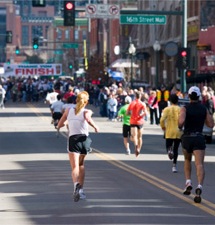
Pain is a harsh reality for many of us who choose to run as a means of getting fit.
Sore knees, ankles, shins or hips lead us to believe that we're simply not built to run.
This is a real shame because the majority of these pains can be completely eliminated with some targeted injury prevention work.
Almost any niggle which gets progressively worse when we run is simply a result of certain muscles becoming stronger and shorter. When muscles shorten to a certain length they either pull bones out of their natural position or cause inflammation at the site where muscle attaches to bone, via ligaments.
Sore Knees while Running
One of the most common niggling pains people associate with running is a soreness which develops around the kneecap.
This pain is usually as a result of the front and outer thigh muscles pulling the kneecap out of the position it is most comfortable in when running.
Every time our foot lands the thigh catches our entire body weight which can result in a reasonable amount of muscle damage after enough foot steps. This then leads to the muscle repairing in a slightly shorter position unless we do something to bring the muscle back to its normal length.
Knots of repaired muscle tissue form in the muscle which effectively prevent it from releasing back to its healthy length.
Massage for Runners
Massage is an effective way of getting rid of the knots. If you've ever had a sports massage you'll have noticed that the therapist will gravitate towards the knots and apply pressure to effectively smooth them out.
Professional Massage can be an expensive way to get rid of knots and although its more effective, self massage can do the job too. Foam rollers allow us to roll tight muscles over them, achieving a blunter version of a massage therapist's hands. Rolling and holding pressure on the most sensitive knots is a great thing to do just before stretching the tight muscle.
Unfortunately, sports massage and rolling hurt when muscles are tight so it helps if you can learn how to adjust pressure on the muscle to make it bearable. Some will say the more pain the better the outcome but we tend to keep away from pain we cannot control so it's best you learn how to control the pressure if you want to make the most of this effect injury prevention strategy.
As a general guide: if massaging a muscle hurts like hell then it's probably one of the muscles causing the joint or bone pain you're experiencing after or during your runs.
Stretching for Running Flexibility
Most of us do some form of warm up or warm down stretching for the thighs but few spend the time required to bring about lasting changes in the length of the muscle. Flexibility stretching requires a minimum of 60 seconds per muscle to bring about lasting improvements but even doing this each run is unlikely to be enough if we're running regularly.
There are a lot of other activities which shorten the thigh muscles. Just sitting at a desk or standing up for extended periods of time can encourage the muscles to shrink to better accommodate that position. Strength exercises such as the squat, lunge, leg press and any jumping exercises lead to strengthening and shortening of the thigh muscles. Ditto, rowing and cycling, skipping and every push off from the wall when we swim.
The reason running tends to remind us about the sore knees more than these other activities is the impact but if the muscles were not so inflexible then they may not hurt at all.
It's easy to visualise the pain from running coming as two bones are squashed together by the weight of the body as it lands from each step but this is rarely the cause of knee pain unless there has been significant wear of cartilage or an accident where cartilage or other joint padding has been damaged.
Other Injury Prevention Strategies
Strength and stability training can also improve the muscle's ability to cushion landing forces but unless the muscles are free and flexible they can still cause pain.
Another sure cause of running injuries is simply going too fast and or too far. If we haven't run 5k in the last two months then running 10k with any amount of speed is going put a lot of stress on the muscles, ligaments and bones of our legs.
We all love the feeling of running fast enough to get our lungs working but in order to make this happen we have to run reasonably fast for our current running ability. Our legs need to do some short and slow runs to build up some durability before they can handle regular high intensity runs.
Run at a pace which you can maintain a comfortable conversation at when getting back into running. Your legs will start to feel heavy and that's a good sign that they've had enough for that particular run. With any luck you'll have a small amount of muscle soreness which you can stretch out over a couple of days, then get back out for another run.
This is far more effective than obliterating your legs by running too fast, not stretching or massaging then doing the same thing, only faster a week later when your legs have finally recovered from the previous workout.
Summary
If you avoid running for fear it'll aggravate a niggling joint then don't give up hope. Start rolling and stretching your calfs, front and outer thigh to address pains in the shins, knees or achilles tendon. Progressively rebuild your running distances at conservative speeds and you'll find that the pains have simply stopped.
This article has provided some ideas for how you can stop running from causing you pain but figuring out exactly what your personal causes of pain are is obviously not possible without assessing your situation.
If you'd like help rehabilitating an injury contact your local physiotherapist. If you'd like help with your running fitness and injury prevention then contact the STS Fitness Running Club.
The STS Running Club provides speeds for every member to run at, which are based on the individual's time trial result. This means each run is paced correctly for the current condition, taking into account any events which need to be peaked for.
There is a free membership and paid memberships starting from just £20/month for those who want programmes and one to one coaching.
Whether you're running to improve general health, lose weight or beat a previous best time, motivation to progress your running through the winter months can be tough.
It's obviously colder but just as importantly the hours of daylight are significantly less.
While there are good strategies to combat these obstacles some of us enjoy the fact that running is convenient and most of those strategies simply do not suit.
This article will focus on how you can take your running to another level using the Trusty Treadmill. But the Treadmill is so Boring!
We hear it all the time. Running on a treadmill does not allow you to:
feel the breeze evaporate sweat from your skin
to see the end of your run approaching as you drive yourself forwards
to negotiate the various imperfections of the footpath, trails or fields
I get it...Running outside rules, but the treadmill does offer some advantages which outdoor running does not:
knowing that you're about to run on a consistent surface
drink bottle at hand (not in hand the entire run)
a clean toilet less than 20 seconds away
an automatic pacing and incline system
a tv with audio
the ability to run with a friend who is twice as fit as you
I'm not saying I prefer to use a treadmill by any means but if it's dark, wet, slippery and freezing outside when my clients are supposed to be running then I have no issue with suggesting they use a treadmill.
Strategy 1. Follow a Progressive Running Programme
The best way to motivate yourself with anything is by achieving success with it. If your running programme calls for you to run for a certain duration or distance and actually provides a speed which is based on your ability then you can see before taking a step exactly how your fitness is going to improve over the next 2-6months.
Programme Session Plan Example
All you have to do to achieve the success, so vital to your motivation, is stick to the programme. Each workout you do is a step in the right direction and treadmills make this easier than ever.
Running outside takes you out of a stable environment and makes following a structured running programme much harder to achieve. If the programme is based on you running speeds in a stable environment such as an indoor tack or treadmill then there's a good chance that unless you train in this environment regularly, you're going to struggle to keep to the session plan.
Wind, inclines, foot traffic, puddles, mud and hail can all disrupt your running rhythm which will lead to inefficiencies and therefore higher intensities than were originally intended by the programme designer.
A treadmill on the other hand allows you to focus on maintaining good form and rhythm meaning you can carry out the workout as it was supposed to be performed.
A truly effective running programme will offer a minimum of two workout routines which progress at effective and sustainable rates. If you're just getting back into running then one of those workouts should address your technique.
Strategy 2. Practice Good Running Technique
Running Technique drills are the easiest way to get fast improvements in
your running. You don't need to run long distances if you're just
getting back into it.
One longish run (whatever distance that is for
you) and one or two shorter runs with a technique element should allow
your legs to strengthen up without leading to chronic injuries such as
achilles tendonitis or one of the many forms of shin splints.
It's so common for runners to over-stride when trying to bring more speed into their workouts. Over-striding is what happens when your foot lands in front of your centre of gravity. It not only leads to breaking forces but increases your chance of injury thanks to the lengthening of the hamstring just as the force of your full body weight travels through it.
Running Technique Drills can teach you to land the foot correctly as well as improve:
your running efficiency
speed when you need it most
running posture
your breathing capacity
leg drive and recovery
much more...
You can find most of the running technique drills online these days but unless you've got someone to provide feedback, you're completely in the dark.
STS Fitness holds Running Technique clinics for people who want to take their ability to a new level.
Stationary cycling classes are extremely popular with cyclists and are responsible for making thousands of non-cyclists think again about using their bike for exercise.
While Treadmill Fitness Classes have not taken off in the same way, they're on the rise.
Thanks to the latest developments in fitness conditioning methodology, conditioning coaches can now run classes which push multiple participants to similar intensities, taking into consideration the wide range of abilities.
STS Fitness holds RunFit Classes at Fitness First in Cheltenham for anyone looking to:
train towards a 5k, 10k or half marathon
improve stamina and endurance
increase running speeds
get a fun and high energy workout
burn calories fast
improve their metabolic rate
So what do you think about Treadmills?
Do you use one to get the mileage up through winter or stick steadfast to the great outdoors?
The Honeymoon Period
We're well into the New Zealand winter sports season now so if you're playing something like rugby, football, netball or hockey you've made it through the warm, dry spell which the early season puts up year after year.
The Dark Days are Coming
You know it's coming though...It's already dark at training since the days have shortened and the temperatures are starting to drop. We've had a few wet weeks already but there's far worse to come. June and July in New Zealand club sport is where the season is won or lost.
Many teams training attendances fall due to the various thresholds of "fair weather trainer" each of us posses. Many clubs have indoor venues they can use but these are often reserved for the top teams. Even having a training moved to the gym is enough to turn many club sports people off training for the night due to a lack of space and preparation on the coach's behalf.
Capitalising on the Competition's Failings
These "worst of winter months" are an ideal opportunity for any club to make a big move in there standings come the business end of the season. By targeting these months as keys to success and really pushing the players to take ownership for making the most of it, any team can find themselves a far fitter, more cohesive unit each game-day.
Optimising Team Trainings
Coaches need to have indoor sessions planned for this time of the year and many do. If the players know they're going to get a good training regardless of the weather then they're more likely to turn up. Setting up circuit for skills and fitness phases of the training keeps athletes moving and on their toes. This really is the bare minimum requirement as no one wants to stand about listening to the coach talk in an unheated hall or freezing southerly.
Setting a work and recovery time for every game and drill let's everyone know how long they're going to have to work for and how much rest they're going to get. This increases the energy again, especially in a game situation whereby the coach is giving score and time updates regularly.
Rolling Subs vs 3+Teams
One format I'd like to see all coaches change is whether to have two teams with rolling subs or 3+teams whereby two teams play while one or two teams sit out. While the latter scenario is most common it allows athletes to cool down and get bored for too long.
Having two large teams with rolling subs means those on court have to work hard then get off. The coach needs to drive this concept as there will always be those who just want to stay on the entire game. This is another opportunity for the coach to develop team players who recognise when they're too tired and need to sub for the better of their team.
Part 2: Optimising Each Individual's Trainings...coming soon!
Thursday, 26 May 2011
A Fitness Philosophy to Change Your Life
-from the STS Fitness and Nutrition Website: www.sts.co.nz
Imagine being so excited about exercise that it's all you could think about...
What would that do for your Wellbeing?
What would that do for your Body?
What would that do for your Life?
Finding Success in Fitness
We were not all born into exercise but every one of us has the ability to love it. All we need is success.
Success is what motivates us to do anything so if we want to improve our fitness then we need to feel like we've succeeded each time we put some effort into it.
The number one reason people give up when they come back to fitness is a lack of success in losing weight.
Weight Loss as a Motivation to Exercise
It's human nature to want constant rewards for anything we dedicate ourselves to but many of us are dedicating our lives to losing weight. Regardless of how dedicated we are, losing weight does not provide success regularly enough to keep us motivated.
Even if we do achieve early success, our constant need for more deems that unless we continue, we will soon get down on ourselves and do something which makes us feel better. For a lot of weight loss enthusiasts that something is often destructive to our weight loss pursuit. We all know how to gain weight...
Next thing we know we've actually lost ground and feel less motivated than before we started.
Training for Sport as a Motivation to Exercise
Sport has a way of getting us hooked to exercise. If some initial interest is fostered properly it can quickly turn into a whole new way of life.
Start with the right level of abilities and you’ll receive positive feedback from a range of people. Each time you get feedback it’ll make you enjoy your new form of exercise that much more and strengthen your resolve to keep it up.
Better yet you can see improvements in what you can do within just one training. Take note of where you started and you’ll be amazed by just how much you’ve improved every few weeks.
Contrast this with the motivation you get for losing weight:
· No one will notice you’ve lost weight until it is significant.
· The same person, such as a trainer or spouse, telling you that you’re looking great only motivates you so long before you realise they’re just being nice.
· You won’t look different in the mirror for at least 2months.
· Your clothes won’t fit better for at least 2months unless you do something radical and probably unsustainable.
Becoming an Athlete
People who consider themselves athletes do not need to be fit, thin, muscular or even "athletic". They simply think of themselves as an athlete.
The word "Athlete" can be substituted for more specific terms such as a Runner, Swimmer, Footballer, Weight Lifter, Dancer or any other adjective which involves fitness.
By thinking of yourself as an athlete you'll gain your motivation from every new skill you learn. Every time you become even remotely more effective in doing what you do you'll feel the success and increase your motivation.
Now you may be thinking: "Learning a new skill won't make me lose weight. I don't even like sports."
Learning the skills of whatever new activity you choose will increase your ability to do what you do.
Being able to do anything better than before increases the chances we'll keep doing it.
If the activity you choose requires you to use energy then it's going to help you lose weight. Find Your Inner Athlete Now!